LIVE, ONLINE MASTERCLASS [FREE]
Why Productivity Feels Safer Than Rest
(Even When You're Exhausted)
How High-Functioning Adults Get Stuck in Survival Mode and What It Actually Takes to Regulate
JOIN THE WAITLISTYou get things done.
From the outside, you look composed.
Reliable. Capable. High-functioning.
You manage responsibilities.
You meet expectations.
You rarely fall apart.
But internally, you feel tired in a way that sleep doesn’t fix.
You tell yourself you’ll slow down after this week.
After this deadline.
After this season.
And yet… you don’t.
Because stopping doesn’t feel relieving.
It feels uncomfortable.
Sometimes even unsafe.
If productivity feels easier than rest,
this masterclass will explain why.
What’s Actually Happening in Your Nervous System

The Nervous System Prioritizes Safety
Your nervous system is built to detect safety, not maximize productivity.
When it senses pressure, unpredictability, or emotional risk, it shifts into protection.
That protection might look like analyzing, planning, and handling it all.
If being competent has helped you feel safe, your body learned to value performance over vulnerability.
Over time, that association becomes automatic.
Productivity Becomes Regulation
When productivity consistently reduces discomfort, it stops being a preference. It becomes our default.
Being busy becomes your baseline. Achievement creates relief. Forward motion feels stabilizing.
It's not because you love hustle, but because your nervous system feels more settled when you’re doing.
Slowing down removes that stabilizer.
And without it, your system doesn’t feel calm. It feels exposed.
Survival Mode Can Look Functional
Survival mode rarely looks chaotic.
In high-functioning adults, it often looks responsible. Reliable. Driven.
You’re not spiralling. You’re not shutting down.
But you’re bracing (quietly).
Operating from low-grade activation. Rarely fully powering down.
And until your nervous system learns that safety doesn’t depend on performance, the cycle continues — even when you’re exhausted.
If productivity has become protection, what changes the pattern?
Not pushing less.
Not managing time better.
Not forcing yourself to “relax.”
Regulation isn’t about removing ambition.
It’s about teaching your nervous system that safety doesn’t depend on performance.
That means:
• Expanding your capacity to slow down (without worry)
• Increasing tolerance for stillness
• Reducing baseline activation (not just coping with spikes)
• Building internal safety that isn’t earned through output
This is much more than mindset work.
And it's not about eliminating stress entirely.
It’s about shifting your baseline so productivity becomes a choice, not a requirement for feeling okay.
In this live masterclass, I’ll walk you through how that shift happens.
What You’ll Learn:
In this live masterclass, you’ll understand:
• Why productivity can quietly become a nervous system protection strategy
• The subtle signs of functional survival mode in high-performing adults
• Why slowing down can feel dysregulating (even when nothing is wrong)
• The difference between coping with stress and expanding nervous system capacity
• What actually shifts your baseline so rest no longer feels threatening
This isn’t surface-level stress advice.
It’s a structural look at why your body stays “on” and what changes that pattern.
This Masterclass Is For You If...
• You’re capable and responsible, but rarely feel fully at ease
• You struggle to slow down, even when you want to
• You feel “fine” on the outside but wired underneath
• Rest feels uncomfortable instead of restorative
• You’ve normalized stress because you function well
• You’ve tried mindset work — but your body still defaults to tension
This isn’t about eliminating ambition.
It’s for high-functioning adults who want to build sustainable regulation without sacrificing success.

About Christina
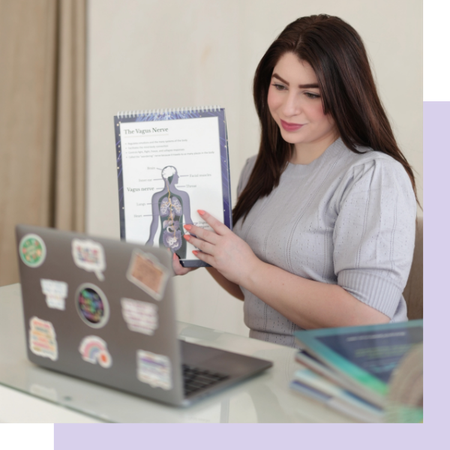
Christina DeFranco is a Registered Psychotherapist (Qualifying), Registered Yoga Teacher, and Certified Mindfulness Meditation Practitioner specializing in nervous system regulation and identity-based stress patterns.
She works with high-functioning adults who appear composed externally but operate from chronic internal activation.
Her work integrates narrative psychology and nervous system science to help clients shift from survival-based productivity to sustainable capacity.
This masterclass reflects the same framework she uses in her clinical work.
You don’t need to become less ambitious.
You need a nervous system that no longer depends on performance to feel safe.
If productivity feels easier than rest —
this masterclass will help you understand why.
Join the live session and learn what actually shifts the pattern.
PS: If you register, you’ll receive the replay if you can’t attend live.